Did you already read part 1 (Days 1-3) of this journey? If you missed it, catch up with us here.
On Day 4 of our passage, things began to change. The wind and sea state slowly started to build, and we spotted the infamous mackerel skies overhead.
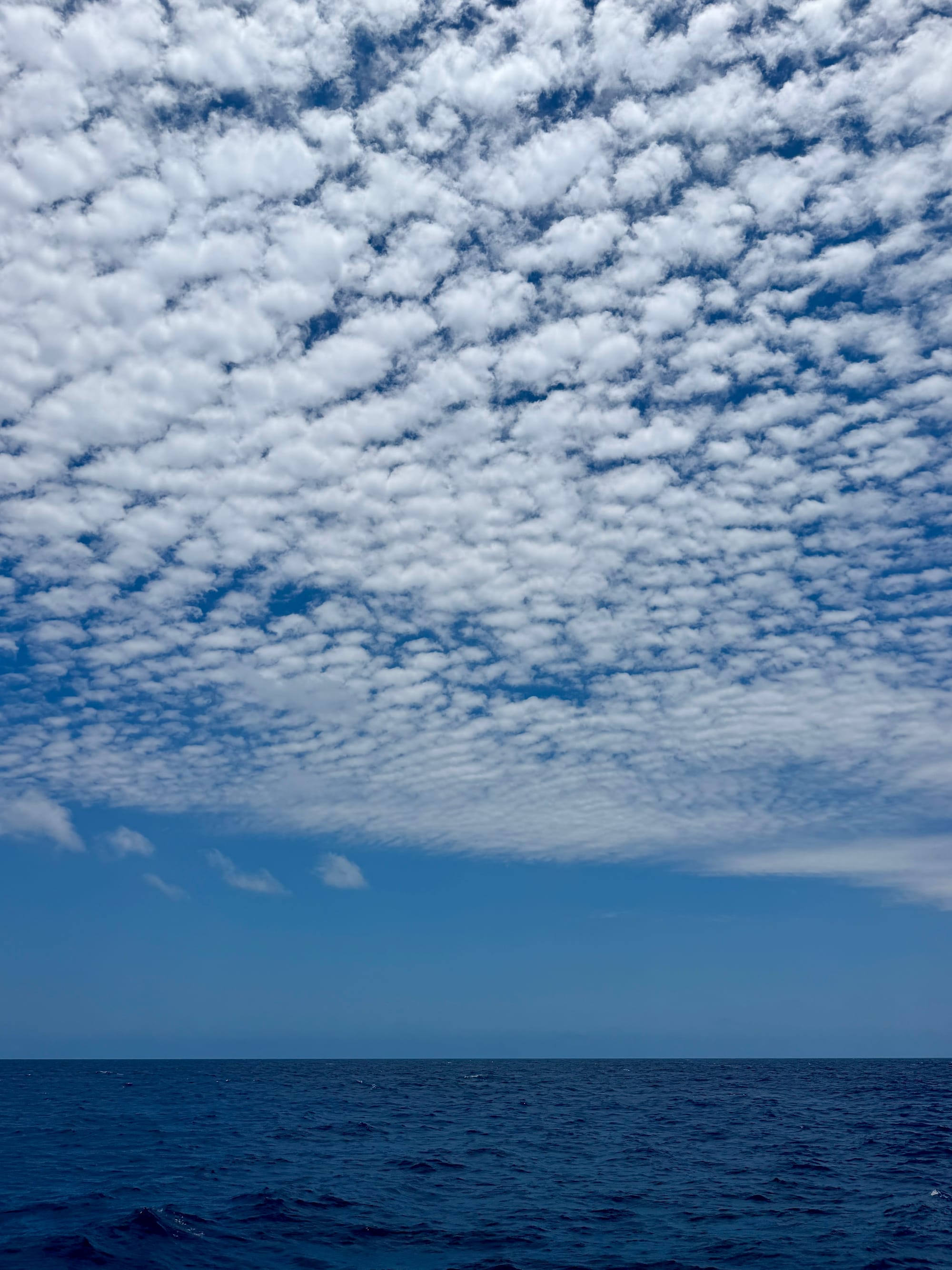
These distinctive cloud formations, resembling the scales of a fish, are usually a sign that a change in the weather is on the way. There are old maritime sayings, “Mackerel skies, not 24 hours dry,” and “Mackerel sky and mares’ tails make tall ships carry low sails.” Mares’ tails are long, wispy, feather-like clouds.
Of course, with modern weather technology, these changes rarely come as a surprise. Our weather routing software had highlighted this stretch of the route as an area with an increased risk of thunderstorms. We'd been watching the forecast for weeks, and it seems these storms were rolling through almost every day this time of year.
Sure enough, by noon the wind had picked up, and we were sailing again. Before long, we had a pod of dolphins come to visit! I didn't make it all the way up to the bow to watch them, though. We were surfing some pretty big waves, and Ray was asleep. We have strict safety rules between the two of us, so per our agreement, in conditions like that, I would have needed to put on a PFD, clip in, and wake him before going forward of the helm. And with all that salt spray flying, I probably would have gotten soaked anyway!
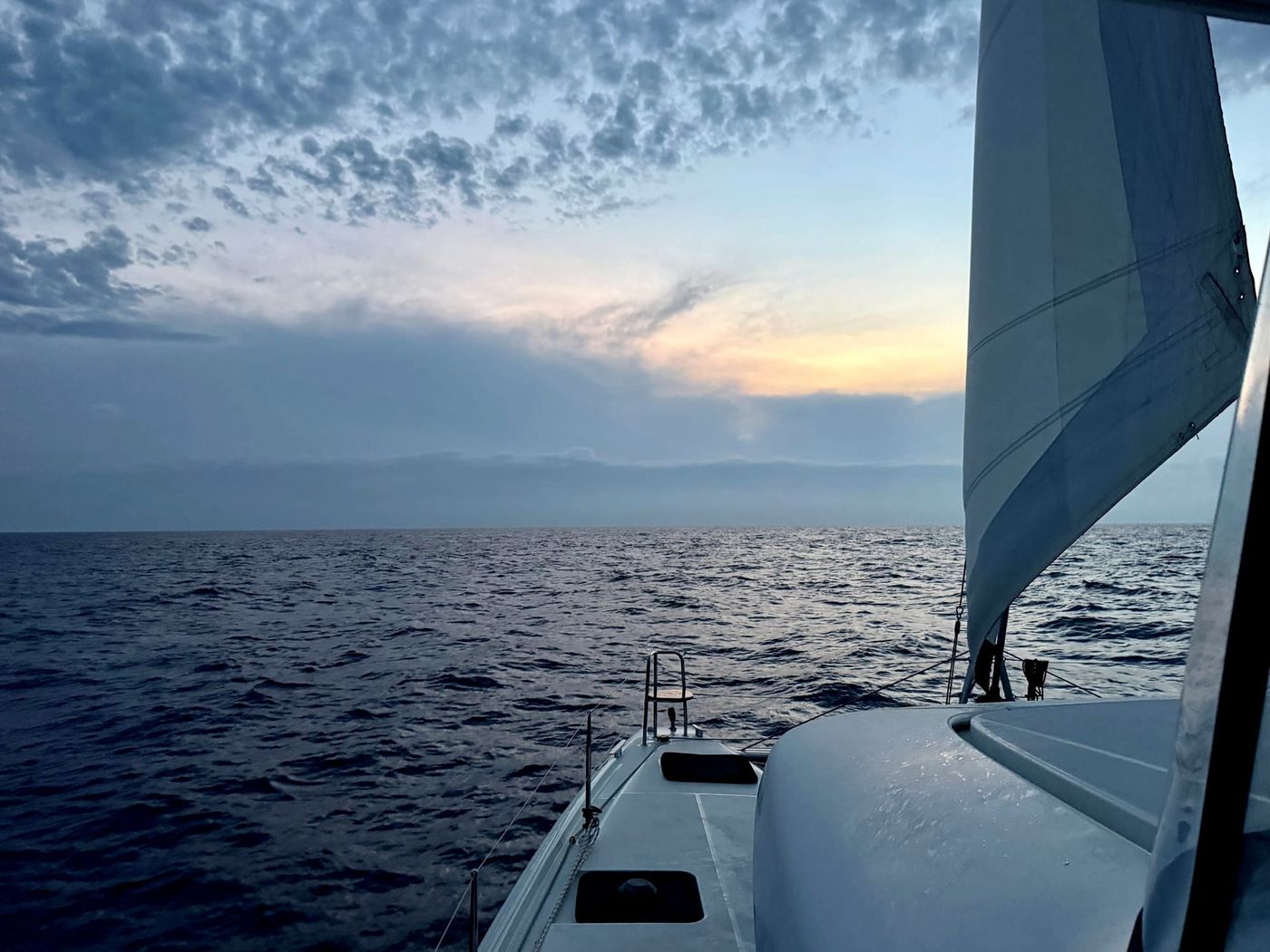
We reefed before dinner, knowing we'd likely be dodging squalls throughout the night. As the sun began to set, we could already see flashes of lightning on the horizon.
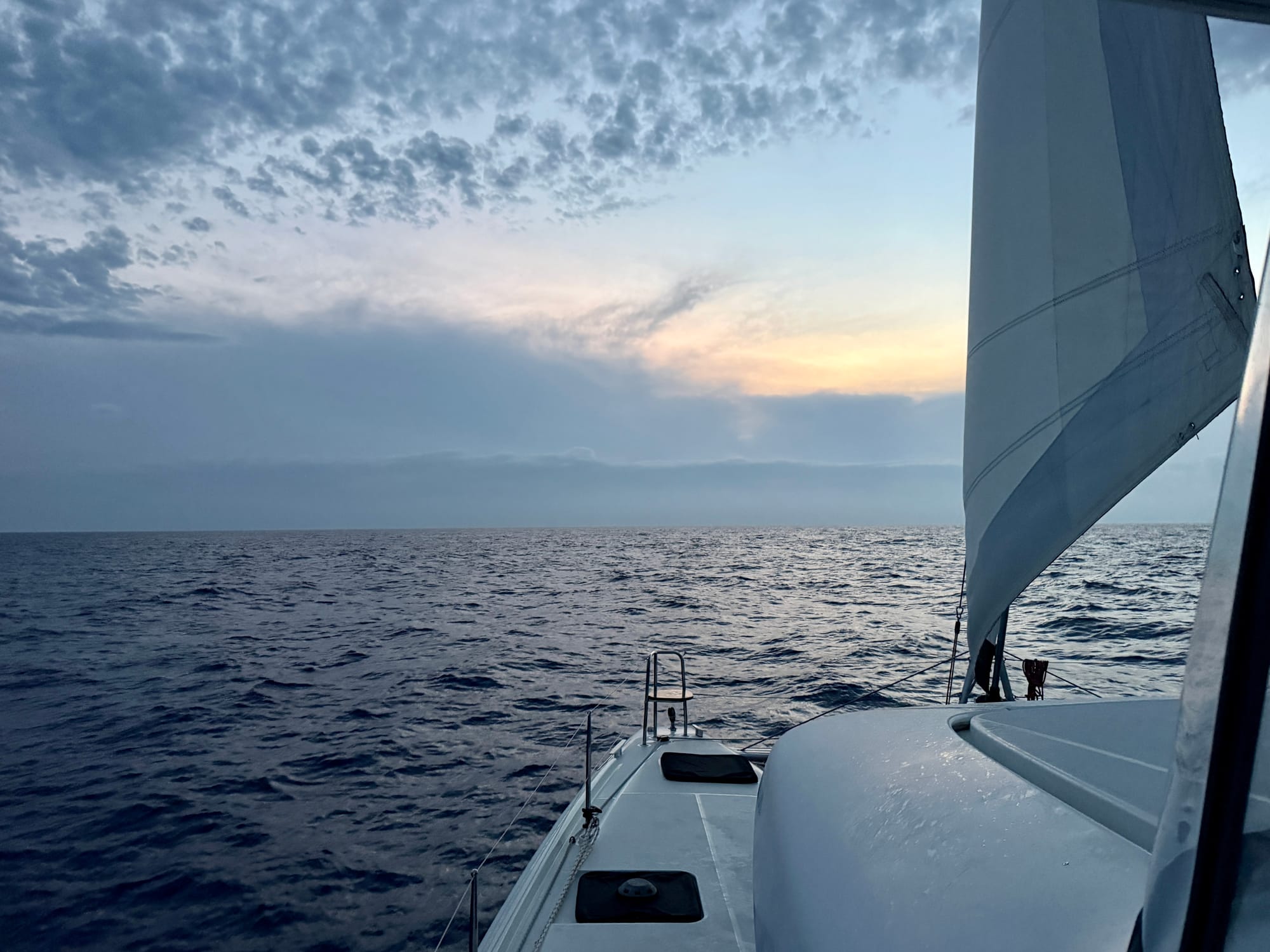
I’m no meteorologist, but I believe that horizontal line in the photo is called an inflow band: a ragged, horizontal band of low-level cumulus clouds that streams into a thunderstorm's main updraft. We could see the storm system was moving from our starboard side toward port, so we slowed down to give it as much time as possible to pass ahead of us. Our options were limited by the wind angle and sea state, though, and slowing down didn't necessarily mean we could avoid everything. The radar showed squalls scattered all around us, constantly moving, growing, and shrinking.
So far, we'd managed to dodge them. We hadn't seen much rain or experienced any significant gusts, but I was getting increasingly anxious about what we might be heading into.
During my second night shift, I woke Ray. The wind had just died, and the jib wasn’t particularly happy about it. However, we were about to be swallowed by the next squall, so despite the apparent lull, we discussed putting a second reef in the mainsail. Ray came up to the helm, and we began the process. We started the engine and furled the jib. I watched the wind speed climb from 7 knots to 15, then 22, and finally 30+ knots in a matter of seconds.
I no longer felt silly for suggesting two seemingly contradictory things at once: bringing in a flapping jib because there was barely any wind, while putting a second reef in the mainsail in anticipation of what was about to hit us. It turned out the lull was only the calm before the storm.
We were already in position to reef, but as the wind continued building and we saw lightning, we decided to drop the sail altogether and wait for it to pass.
We motored back onto course just as the rain began to pour. This was when we discovered that one of the zippers on our helm enclosure door had no pull on the inside. Apparently, every time we’d used it before (it was made in New Zealand last year), we’d closed it from the outside and never noticed! A rather annoying design flaw, to say the least. I put on my foul-weather gear, tethered myself to the boat, and ventured out to close it up in the middle of the storm. I’ll have to work out how to modify it with my sewing machine.
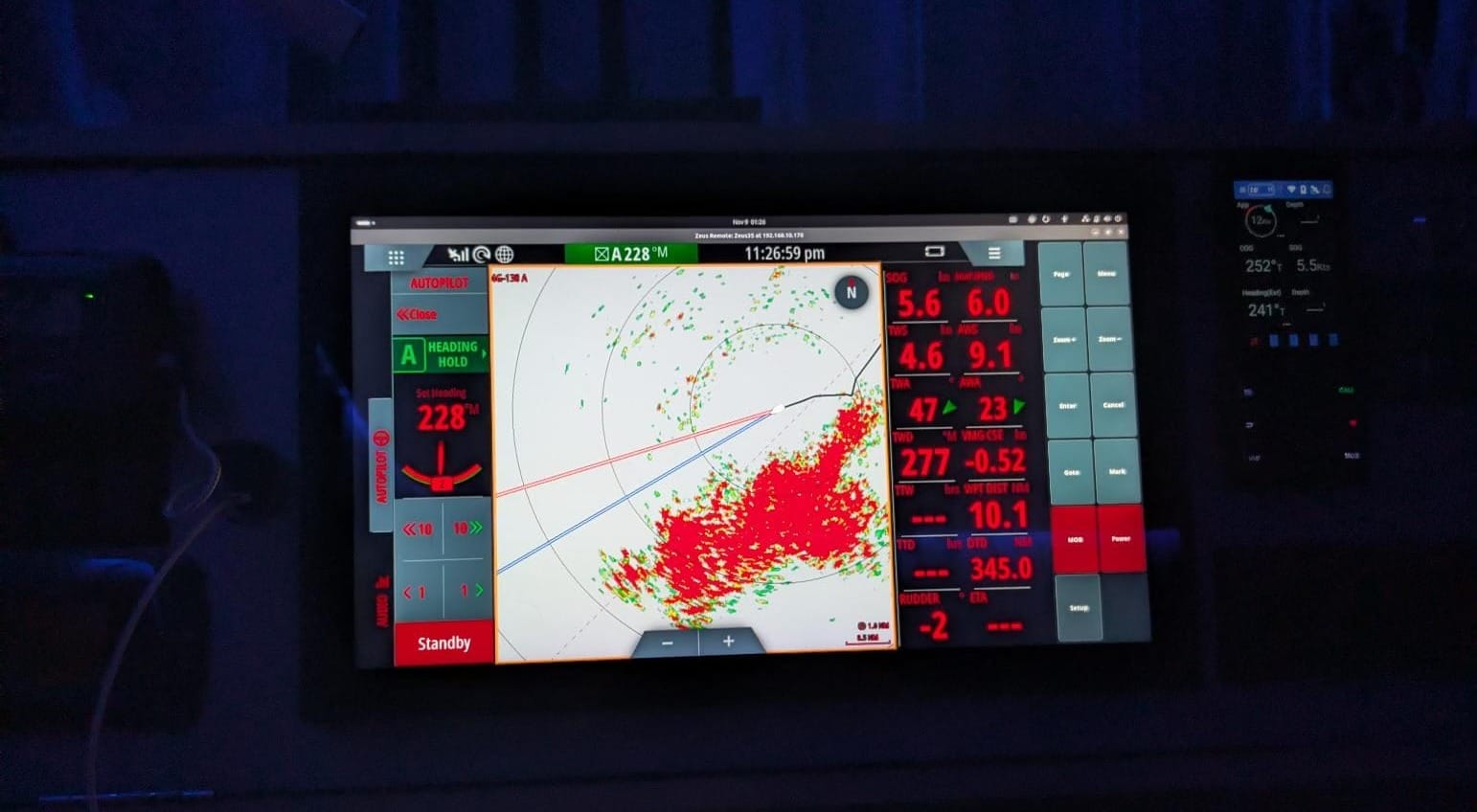
We got hit pretty hard for a while, with periods of strong winds, heavy rain, and some big seas. Lightning was flashing all around us, so we put our iPad and handheld VHF radio inside the oven, using it as a makeshift Faraday cage, a classic old school sailor’s trick. The idea is that the metal enclosure can help shield electronics from electromagnetic energy, potentially protecting them from a lightning-induced electrical surge. If a strike fried the rest of our onboard electronics, we'd hopefully still have a way to communicate and access our charts.
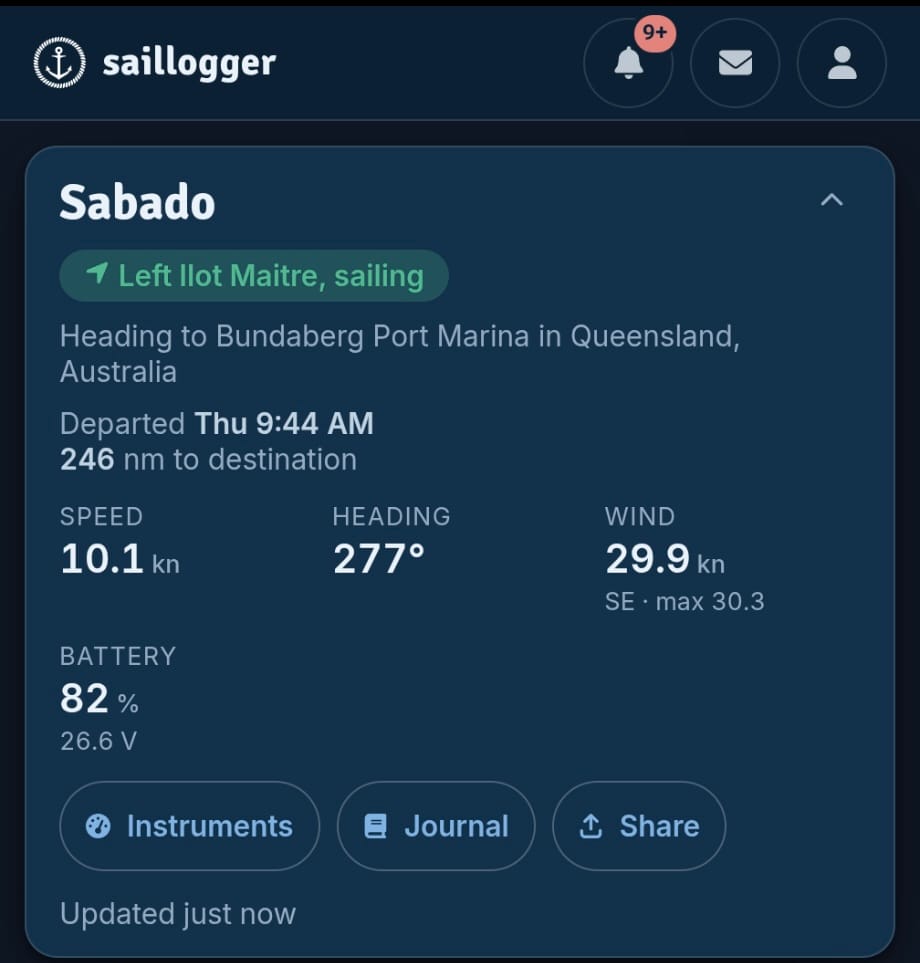
By Day 5, we were both feeling like zombies after barely sleeping the night before. Thankfully, the storms had finally passed, although the seas were still big and the wind was strong. Sabado was absolutely loving it! We sailed all day with a reefed main and the jib out, regularly hitting 8.5 knots or more. That's pretty speedy for this boat.
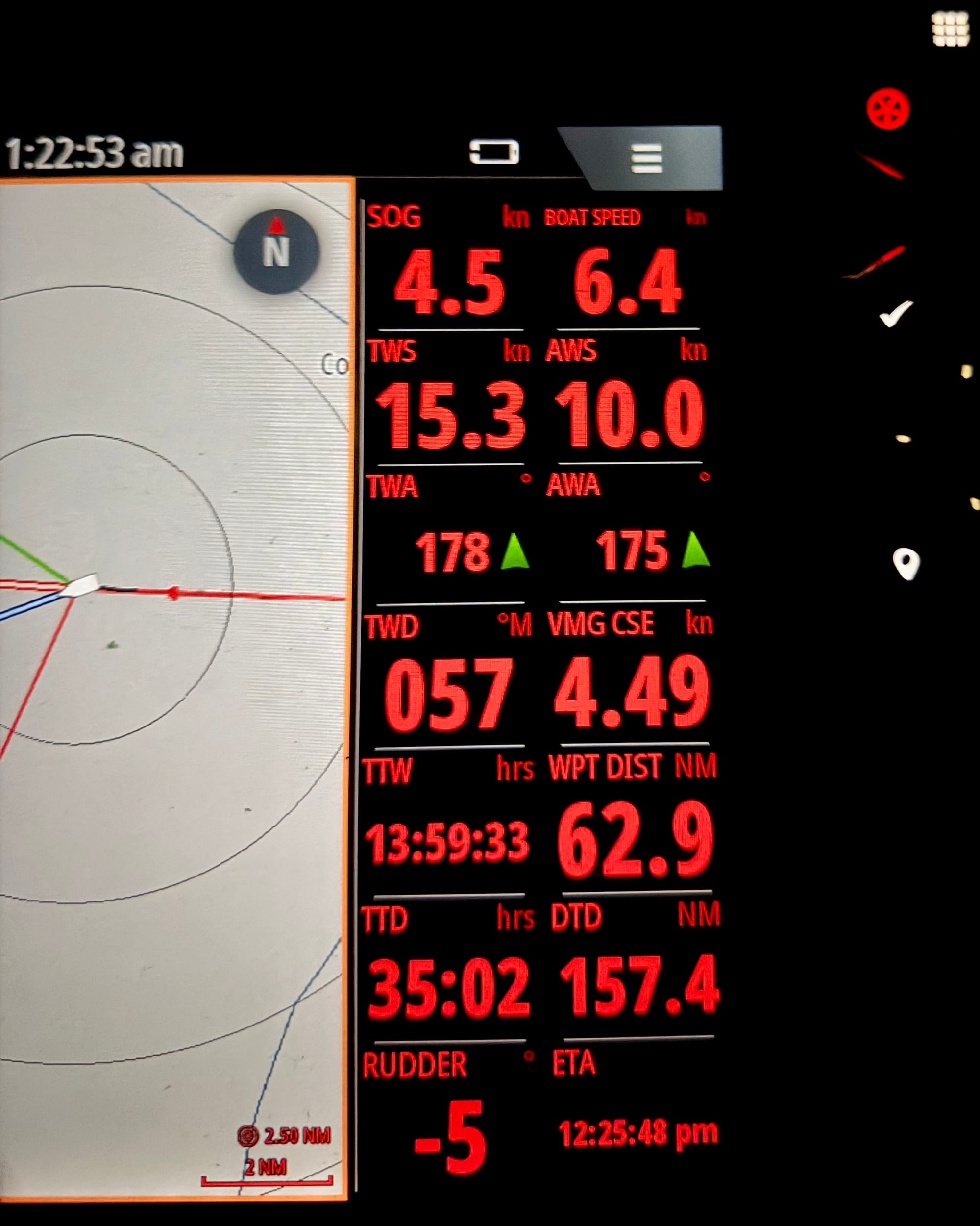
Unfortunately, all that speed didn't translate into quite as much progress as we'd hoped. Overnight, we found ourselves battling a 2-knot current.
If you’re unfamiliar, there's an important difference between boat speed and SOG (Speed Over Ground). Boat speed measures how fast we're moving through the water, while SOG measures how fast we're actually moving over the ground, or in other words, how quickly we're making progress toward our destination. You can see the difference in the numbers on the top row of our chartplotter, pictured below. Even though we were sailing along at ~6 knots through the water, the opposing current was taking 2 knots off our progress, leaving us with an SOG of just ~4 knots. It's one of those frustrating parts of sailing: sometimes you're moving pretty fast, but not getting very far.
By morning, the wind had disappeared and the seas had flattened out as we motored into Bundaberg. Along the way, we passed through streams of what we've been calling "mystery goo." We've since been told it was likely Trichodesmium, also known as sea sawdust.
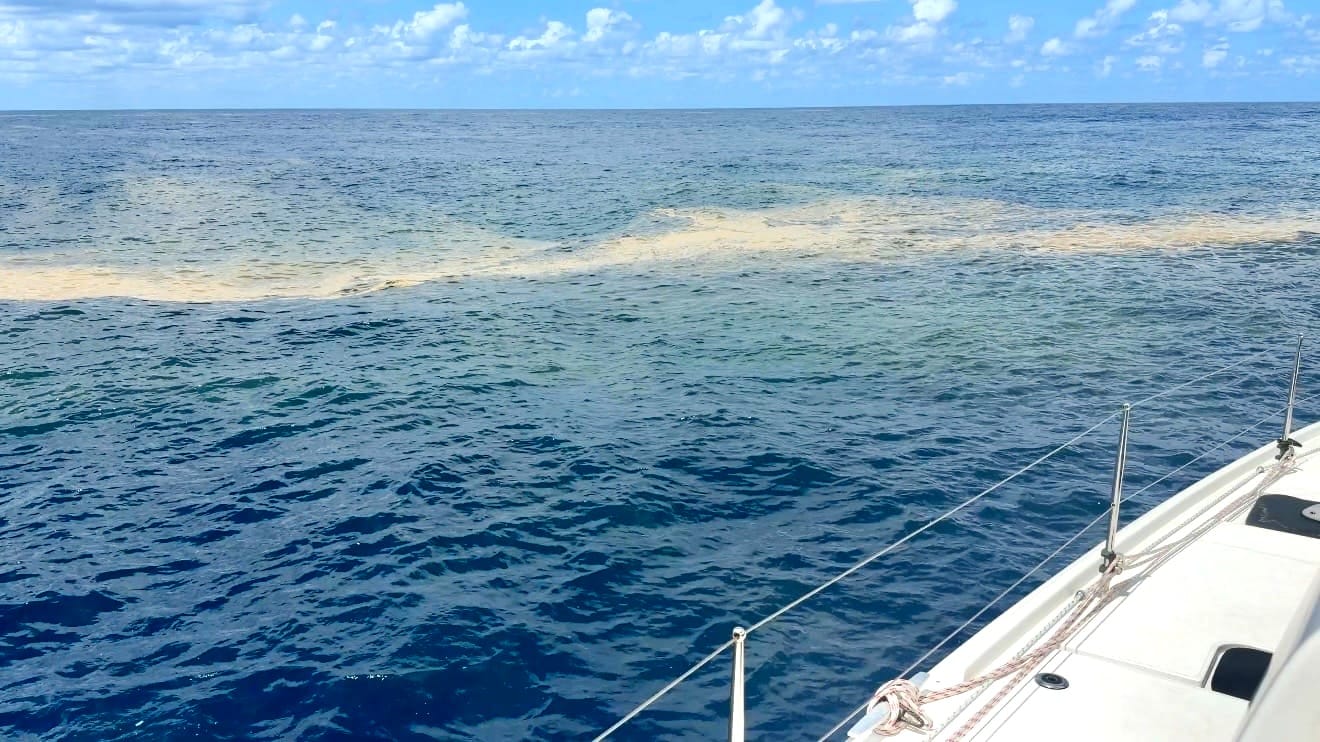
Despite looking like floating dirt or algae, Trichodesmium is actually a genus of microscopic, filament-forming cyanobacteria. It thrives in warm, nutrient-poor tropical and subtropical waters, including the waters around Australia. When large numbers gather at the surface, they form long, brownish or golden streaks that look like sawdust floating in the ocean.
There's even a little bit of maritime history behind this: Captain James Cook and his crew encountered the same strange-looking substance during their voyage along Australia's east coast in 1770 aboard the Endeavour. At first, they were so puzzled by the brown patches covering the water that they thought they might be sailing toward shallow banks or shoals. After checking the depth, they realized the water was just as deep as anywhere else. Cook recorded the unusual phenomenon, the name "sea sawdust" stuck, and people have been using it ever since.
It's pretty incredible to think that more than 250 years ago, Captain Cook was looking at the same strange stuff as us!
We arrived in Bundaberg and tied up at the quarantine dock, where the officials were set to board and search us as a part of the country clearance process, but, that's a story for another day... Thanks for following along on our adventure!