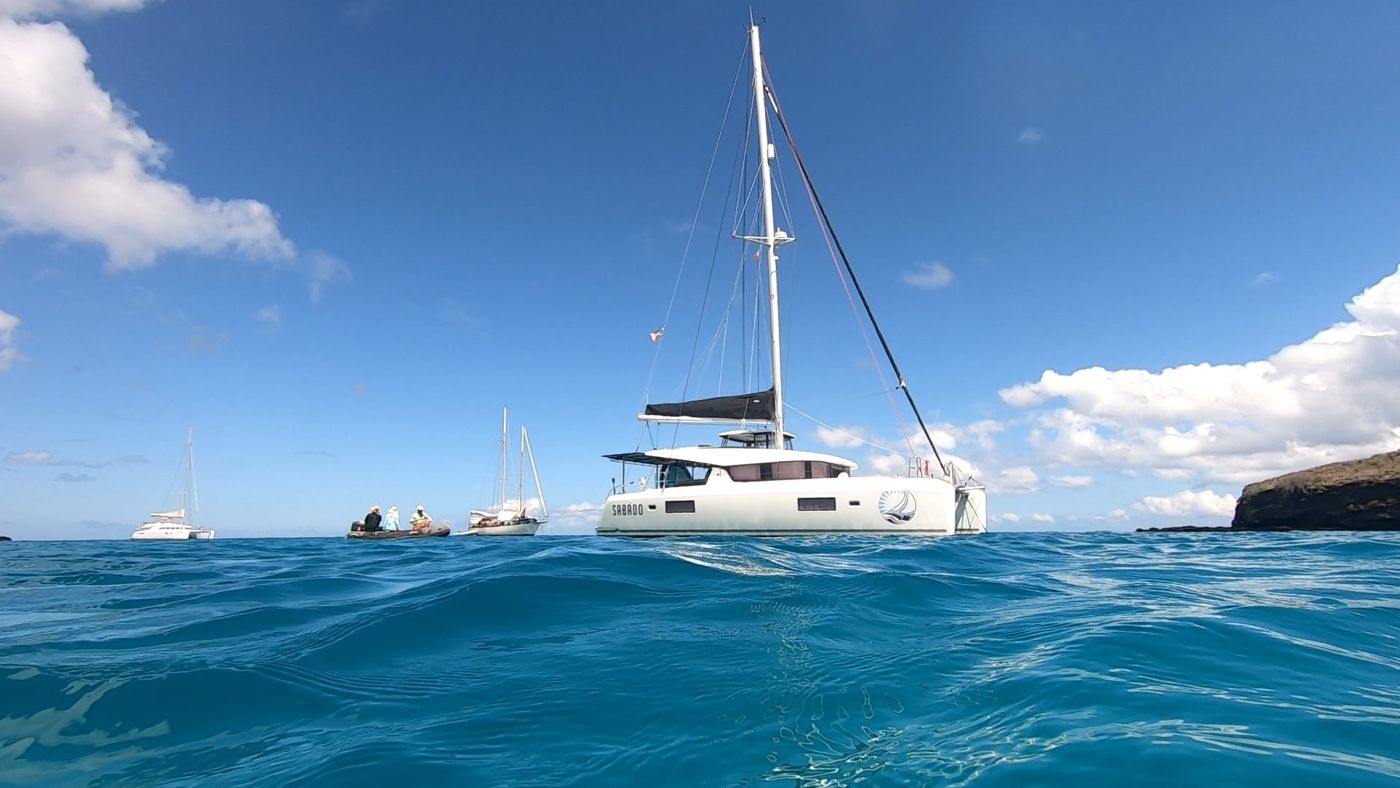
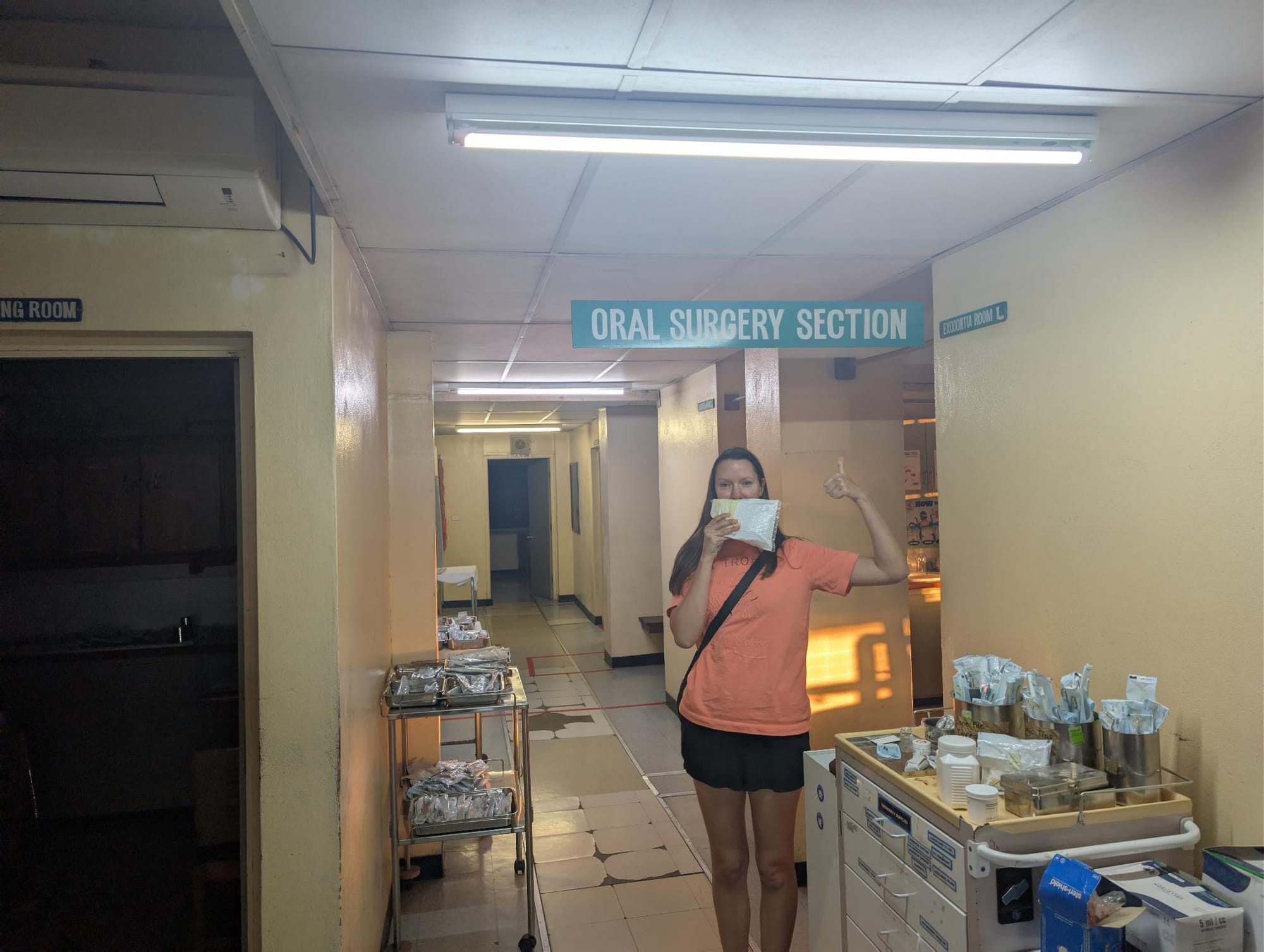
I fell from the coach roof through an open hatch while we were anchored in Fiji and ended up in the local hospital. Ray and I have always talked about what we would do in an emergency like this, but when you're dealing with fear and shock, it's amazing how quickly your ability to think clearly disappears. Looking back, there are several things we could have done to be better prepared for the aftermath of my accident.
Keep Emergency Information for Everyone on Board
This is especially important if you ever take crew aboard your boat. Thankfully, Ray already knew my allergies, medications, emergency contacts, and medical history. If you're sailing with friends, acquaintances, or crew, make sure you have that information before you leave the dock. If they're unable to communicate after an accident, you'll be the one answering those questions.
I've created a free Emergency Information Card that you can print, fill out, and keep in your wallet or purse. I also recommend taking a photo of it and saving it on your phone, but don't rely solely on a digital copy. During our emergency, we ended up on an unexpected two-hour taxi ride to the hospital. If Ray hadn't packed a power bank and adapters in his emergency kit, our phones would have died shortly after we arrived.
The Emergency Information Card is free for anyone to download. If you find it useful, consider adding to our tip jar or becoming a Crew or VIP member to access our full Document Library, which includes additional templates, diagrams, and resources we've created to make life aboard a little easier.
One thing I included on our Emergency Information Card is each person's phone passcode. It may seem like a small, or perhaps invasive, detail, but it can make a huge difference in an emergency. Being able to unlock someone's phone means you can quickly contact their family, access important information, or continue communicating if your own phone dies or doesn't have service. In our case, we had just arrived in Fiji and hadn't yet set up our eSIMs. My phone provider has better international coverage than Ray's, so he used my phone to communicate with my family and research treatment options while we were at the hospital.
Set Up eSIMs ASAP
When we first arrived in Fiji, we checked into the marina and stayed there for a few days before heading out to anchor. We weren't planning to do much exploring until our cruising permit was issued, so setting up our local eSIMs didn't feel like a priority. We had Starlink on the boat, and we expected to spend very little time on shore in the coming week.
That decision came back to bite us.
As we climbed into the dinghy, with me bleeding and in tears, we realized we needed to turn on international data roaming and hope it worked. It was one more thing to deal with at a time when our attention needed to be somewhere else. Even once we had a connection, it was slow. We were trying to find the nearest hospital, look up dental facilities, and dig through emails to find my insurance policy number, all while dealing with an emergency. What we learned is that you should purchase and install your destination's eSIM before you need it, ideally before you even arrive in the country.
We've been using Airalo for years. It lets you purchase and install eSIMs for mobile data in countries around the world without having to buy a physical SIM card. If you've already installed your country’s eSIM, turning it on and connecting to a local network typically takes just a few minutes. In an emergency, having fast, reliable mobile data can make an already stressful situation much easier to manage. It's one less thing to worry about when your focus needs to be somewhere else. Moving forward, we’ll be adding “install destination eSIM” to our predeparture checklist, before leaving the country.
If you'd like to try Airalo, you can save 15% on your first Airalo Unlimited eSIM with the code UNLIMITED4YOU.
Do Not List Your Spouse As Crew
This is something we've always paid attention to, but Fiji highlighted a detail we hadn't considered. When checking into a country, think carefully about how each person is listed on the paperwork. If you're cruising as a couple, both of you should have a status that gives you legal authority over the vessel. Neither of you should be listed simply as Crew.
In Fiji, the paperwork used the terms "Person in Charge" and "Captain." We listed me as the Person in Charge and Ray as the Captain, not realizing that if necessary, Ray wouldn't be able to clear the boat out of Fiji without me being present.
That meant the hours before my flight to the USA were spent tracking down customs and immigration officers on a Sunday so I could officially transfer responsibility for Sabado to Ray. If my treatment took longer than expected or severe weather required him to move the boat, he needed to be able to clear out of Fiji without me. Thankfully, we were able to get everything sorted before my flight.
Looking back, I'm not sure we would have completed the paperwork any differently. There was no way to know which one of us might need to leave the country in an emergency. The lesson wasn't that we chose the wrong roles, but that it's important to understand exactly what those roles mean in each country you visit and to know the process for transferring responsibility if circumstances change.
One thing that is consistent almost everywhere is that someone listed only as Crew generally has no legal authority over the vessel. If you're cruising as a couple, make sure you're both listed in a way that allows either of you to manage the boat if the other is suddenly unable to do so. It could save you a great deal of stress during an already difficult situation.
Join Those WhatsApp Group Chats
If you know Ray and me personally, you know we're pretty antisocial. We enjoy doing our own thing and have never been the type to seek out big cruiser gatherings. So, in the past, we've usually skipped the local rally and marina WhatsApp groups.
Since arriving in the South Pacific, though, we've been making an effort to step outside our comfort zone. Cruising out here is very different from cruising the Caribbean or the Bahamas. The distances are greater, supplies take much longer to arrive, and you're often really far from help when something goes wrong.
We've learned that the cruising community is about much more than socializing. It's sharing local knowledge when the charts are inaccurate and cloud cover makes satellite imagery useless. It's someone convincing a visiting friend to tuck a watermaker part into their luggage for you because shipping one to the islands could take weeks.
And, in this case, it's being able to message a group of people you barely know to ask if someone can go retrieve the key you accidentally left in your dinghy during the chaos of getting your wife to the hospital. Because the only thing that would have made that day worse is returning to the dock and discovering the dinghy had been stolen.
We still aren't the most social cruisers, but this experience reminded us that being part of the cruising community isn't just about making friends. It's about having a network of people who are understand your situation and are willing to help when life takes an unexpected turn. Thank you to everyone who messaged us back in our time of need: Ian, SV Tevake for grabbing our dinghy key, Dirk, SV Moin for boarding Sabado to close all the hatches, Beth and Dave, SV Warrior, and Ben and Ashley, SV Nahoa for sharing tracks and route advice to get to the marina, Chad, SV Ohana for the marina recon, Viki from the Island Cruising rally for helping us figure out which form was needed for customs and immigration, and everyone who sent me messages of support while we couldn't have been more down in the dumps.
The Bigger Lesson: We Paid for All the Right Services and Didn't Know How to Use Them
The lessons above are the practical ones, the fixes you can make this week. But my accident exposed something larger, and it's kept Ray busy ever since. Had my injuries been more severe, or had we not been anchored near a busy port with access to taxis and pharmacies, our response would have been very different.
We are not underprepared people. We have an EPIRB, a satellite beacon and an AIS beacon on each life jacket, an Iridium GO, a Garmin inReach, VHF with DSC, and Starlink. We carry medical assistance membership. We both have international health insurance. However, having all of that is not the same as knowing, in the moment, which one to reach for and what it will actually do.
We had the tools. What we didn't have was the answer to simple questions at the worst possible time: Which number do we call first? Does that one send help, or just money? Does it cover both of us, or only one? Do we call before we arrange a flight, or after? Who actually pays to get someone off a boat if we were a hundred miles offshore? We didn't know off the top of our heads.
When we started pulling our policies and membership documents apart, we learned that some services pay for a rescue only if that same service arranges it, so if you organize the transfer yourself, however sensible that is in the moment, the bill is yours. Some cover one of us and not the other. Some cover the transport but not the care once you're ashore, and some are the reverse. Our coverage has seams, and the seams are exactly where an emergency lands.
There's also a whole category of free help we didn't know existed until we went looking, and it turned out to be one of the best things we found. None of this was hidden, exactly. It was just spread across a dozen documents written by a dozen organizations who each assumed theirs was the only one you'll read.
What We're Building Instead
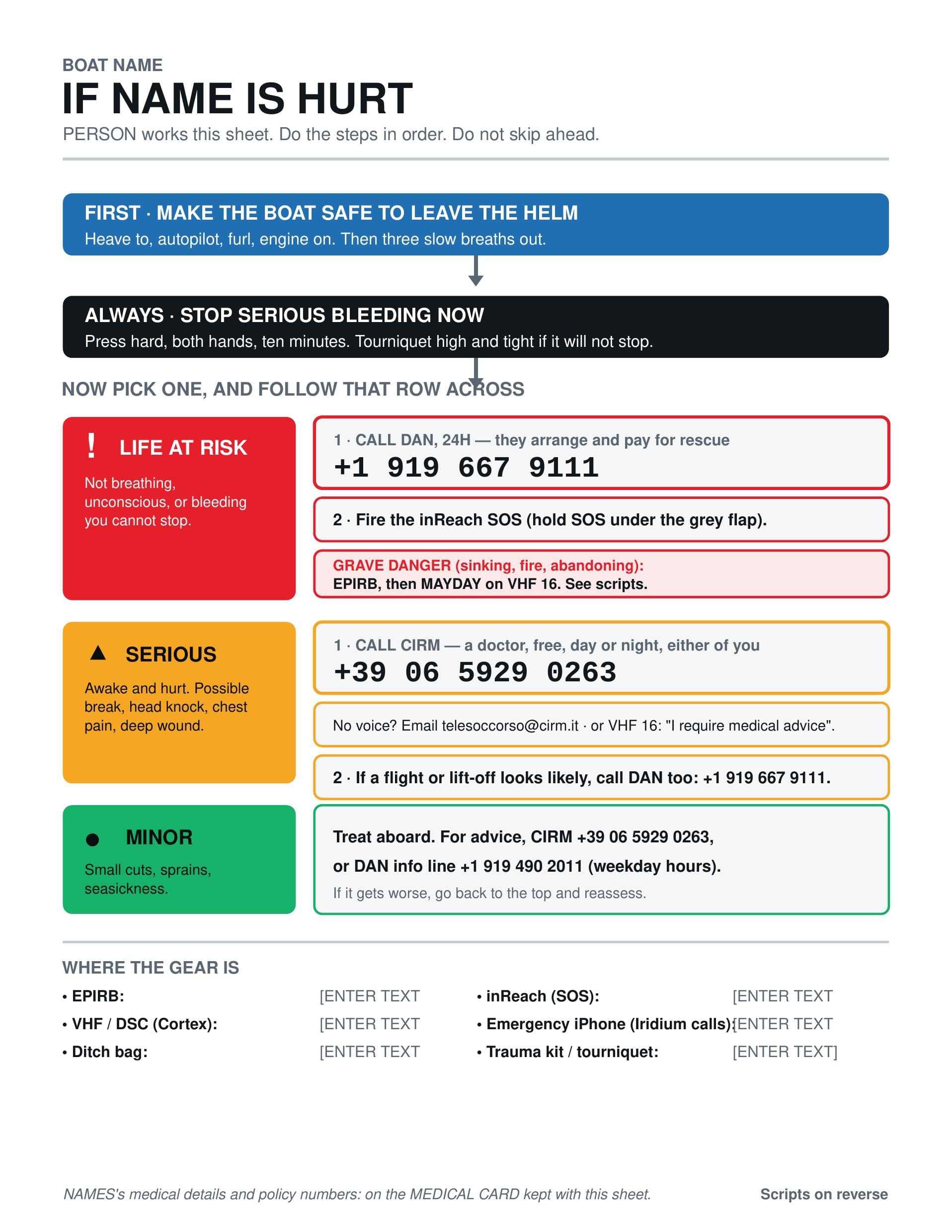
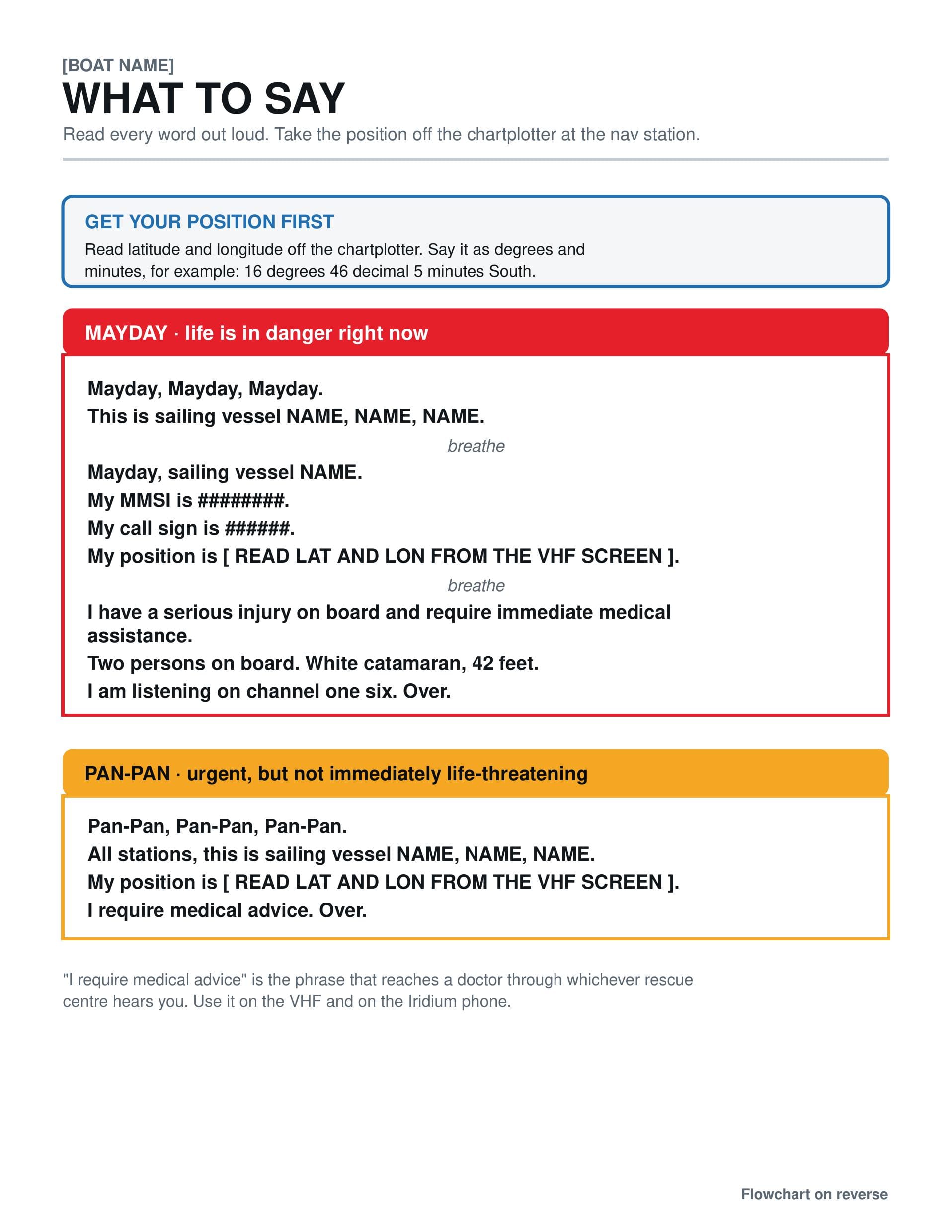
Ray is building the integration manual nobody sold us. For our own boat first, because we need it, and then to share, because if two reasonably careful people got caught out by this, plenty of others will too. It has two parts: the first is a single written manual in plain language, including what we carry and what each piece actually does, with the gaps stated plainly. Then for each kind of emergency, a simple sequence to follow. The second is a tool built into Sabado's monitoring system that turns the manual into something you can use when you're too rattled to think. One tap to step by step instructions. Simple questions to guide you through assessing the situation. The right phone numbers, in order. Our position on screen and the exact words you'd read over the radio. And a place to log what happened as it happens, because afterward nobody remembers the order, and the people who pay the bills will ask.
The guiding idea behind all of it is simple: it has to work when you're at your worst, not your best. In an upcoming post, we'll take a deep dive into that new system: the protocols, the free resources most cruisers have never heard of, and the insurance details every cruiser should understand before they need them. It's the post we wish we'd been able to read a month ago. Until then, below is a document we created that you can edit for your vessel and print now. We hope it never comes in handy!